Turning Bitcoin into cash usually comes down to two options: a crypto ATM, where you insert cash or scan a QR code and receive crypto (or vice versa), or a crypto debit card, which converts your balance at the point of sale. The difference in cost is dramatic — crypto ATMs routinely charge 8–15% while a good debit card costs under 2% — but the ATM has advantages too, including privacy and instant cash. This guide compares the two side by side: real fees, speed, safety, limits, and exactly when each one is the right choice.
Fees: The 8% vs. 2% Gap
Fee structure is where the two options diverge most. Crypto ATMs charge a markup that is baked into the exchange rate — typically 8–15% on top of the market price, plus a flat network fee that can be $5 or more per transaction. A crypto debit card converts at near-market rates with a transparent spread of 0.5–2%, and the best cards charge nothing per transaction.
The math is stark. Cashing out $500 at a 10% ATM costs $50. The same $500 spent through a 1.5% card costs $7.50. Over a year of cashing out $500 a month, the ATM costs $600 more than the card — every single year. For anyone converting crypto to cash regularly, the ATM's convenience comes at a premium that is hard to justify.
Cost Comparison: $500 Cash-Out
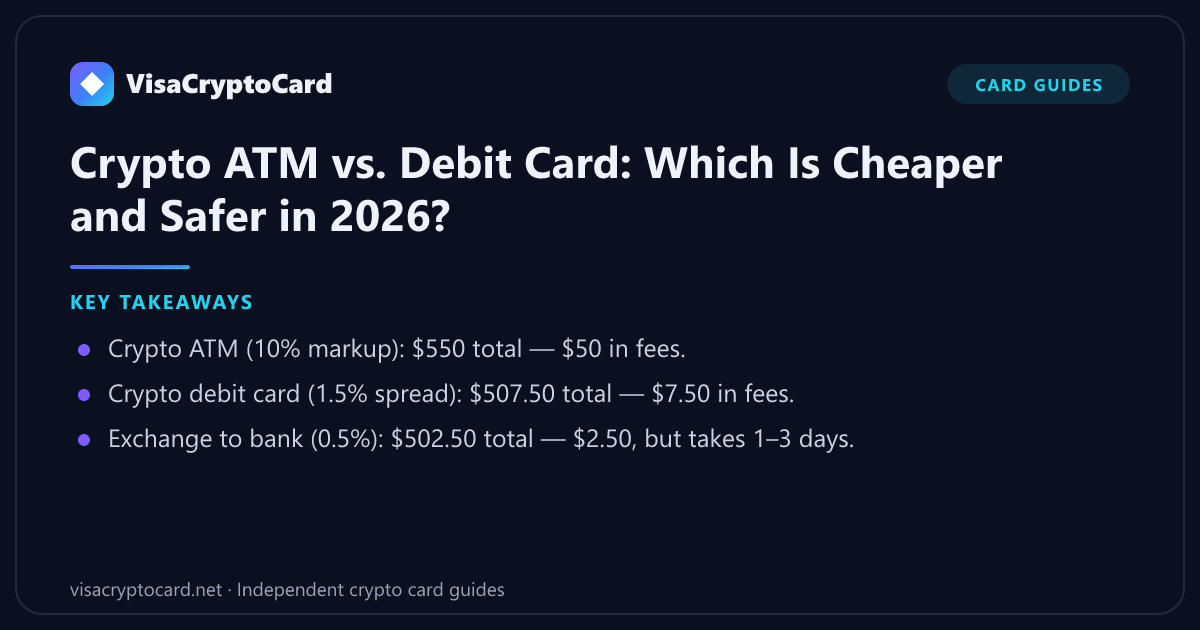
- Crypto ATM (10% markup): $550 total — $50 in fees.
- Crypto debit card (1.5% spread): $507.50 total — $7.50 in fees.
- Exchange to bank (0.5%): $502.50 total — $2.50, but takes 1–3 days.
Speed and Convenience
The ATM wins on raw speed: insert cash or scan, and the transaction settles in minutes with no account, no app, and no wait. That makes it ideal for urgent, one-off conversions. The debit card wins on everyday use: once loaded, it converts at the register in seconds, every day, at millions of merchants and ATMs worldwide. The card also never runs out of location — a crypto ATM might be miles away, while the card is always in your pocket.
For the traveler, the comparison sharpens further. A crypto ATM in a foreign city means finding a machine, accepting its exchange rate, and carrying cash. A card means paying in local currency automatically with a spread under 1%. Speed for a single transaction favors the ATM; speed for a lifestyle favors the card.
Privacy and KYC
Crypto ATMs have a genuine privacy advantage. Many machines allow small cash transactions without identity verification — buy or sell a few hundred dollars with only a phone number. Debit cards, by contrast, are issued by regulated providers and require identity verification (KYC) before you can load or spend. If privacy is your priority, a low-limit ATM transaction keeps your activity off a regulated account ledger.
But the privacy gap is narrowing, and it comes with costs. Many regions now require ID for ATM transactions above modest limits, and cash-heavy behavior can itself attract scrutiny. The regulated card gives you consumer protection, fraud monitoring, and account recovery in exchange for verification. For most people, the trade is worth it — privacy without protection is just risk with better branding.
Safety and Fraud
Safety sharply favors the debit card. A regulated card comes with fraud monitoring, instant freezing, transaction notifications, and a recovery path — if someone skims it, you can freeze it in the app in seconds. A crypto ATM transaction is final: once the crypto leaves your wallet or the cash leaves the machine, there is no reversal, no support desk, and no recourse if the machine is tampered with. Fake machines, skimmers, and "phantom" ATMs that never credit the transaction are real risks in the ATM ecosystem.
The card also reduces the size of the risk: you carry a spend balance, not your entire portfolio. With an ATM, you are physically moving cash or transacting your whole balance on a public machine. If your goal is to turn crypto into spendable money safely and repeatedly, the card is the lower-risk instrument every time.
Limits and Availability
Crypto ATMs are scarce and inconsistent — most cities have a handful, and machine availability, hours, and daily caps vary wildly. Daily ATM purchase limits are often $1,000–$5,000, and finding a machine that supports your specific coin at a reasonable rate is a separate search every time. A debit card is available everywhere a Visa or Mastercard works: tens of millions of merchants and hundreds of thousands of ATMs, with daily limits you set in the app and instant top-ups from your wallet.
For large conversions, the card also scales better. Need to move $10,000 to cash? A card converts it at a sub-1% spread across daily spending and ATM withdrawals. A crypto ATM would charge you $1,000 in fees and likely cap you well below the amount.
Ready to Spend Your Crypto?
Compare crypto cards on fees, limits and availability, then open an account with the provider that fits how you spend.
Get Your Card →When to Use Which
There is no universal winner — each tool fits a situation. Use a crypto ATM when you need instant cash with no account, value privacy over price, or are converting a one-off amount small enough that the 8–15% fee does not hurt. Use a crypto debit card for everything else: regular spending, traveling, ATM withdrawals, online payments, and any conversion over a few hundred dollars where the fee gap becomes real money.
- ATM is better: one-off cash, no account wanted, privacy-first, machine nearby.
- Card is better: everyday spending, travel, sub-2% fees, safety, any amount over ~$200.
A practical compromise many users adopt: keep the card as the default and treat the ATM as a last resort or a privacy tool for small amounts. The 8% fee is a lot to pay for convenience you can carry in your pocket for 2%.
Frequently Asked Questions
How much more expensive is a crypto ATM than a debit card?
Crypto ATMs typically charge 8–15% on top of the market rate, while a crypto debit card costs 0.5–2%. On a $500 cash-out, the ATM costs roughly $40–50 more.
Is a crypto ATM anonymous?
Many machines allow small cash transactions with minimal verification, but larger amounts increasingly require ID. A debit card always requires identity verification from a regulated provider.
Can I use a crypto debit card to get cash at an ATM?
Yes. Physical crypto cards work at regular ATMs, converting your crypto balance to local currency on the spot, subject to daily limits and a small per-withdrawal fee.
Which is safer: a crypto ATM or a debit card?
The debit card. Regulated cards offer fraud monitoring, instant freezing, and account recovery. ATM transactions are final and unreversible, with added risks of skimmers and tampered machines.
How to Calculate the Real Cost of Each Option
Comparing an ATM and a card is easy once you put both in the same units. For the ATM, take the machine's quoted rate and compare it to the live market rate on your phone: the difference, plus any flat fee, is your all-in cost. For the card, take the conversion spread, plus any per-transaction fee, plus the monthly fee divided by your expected spend. A simple formula: total cost = amount × rate + flat fees. Run the same $500 through both and you will see the ATM's 8–15% markup dwarf everything else on the sheet.
One trap: the ATM's advertised "rate" is often a rounded number that looks close to market. The real cost hides in the spread between that number and the live price, which is wider on weekends, at night, and in low-liquidity markets. Always compute the final dollar amount the machine quotes against the live market before confirming. A machine that quotes $52,000 for Bitcoin when the market is at $50,000 is charging you 4% — before the flat fee. Do the math in your head, or better, open a market ticker on your phone before you tap confirm.
The Hidden Costs of Crypto ATMs Nobody Tells You
Beyond the headline markup, crypto ATMs carry several quiet costs. Many machines quote rates that look competitive but include a flat fee on top — $5, $8, even $15 per transaction, regardless of size. The spread widens at night and on weekends when liquidity thins. And some machines charge a second fee when you receive crypto instead of cash, effectively taxing both directions. Add these to the markup and a "5%" machine can easily cost 15% all-in. Always ask for the final amount before confirming, and compare it against the live market rate on your phone before you commit.
Hybrid Approach: When Both Make Sense
The two tools are not enemies. A traveler might use the card for daily spending and a crypto ATM once for a specific cash need where the card's ATM network is thin. A privacy-conscious user might keep the card for regular expenses and use a low-limit ATM transaction for a specific, sensitive purchase. The rule is simple: let the fee decide. If the ATM's markup is under 3% of your amount and the convenience is real, use it. If it is 8% or more, find a card. Over a year, the difference between the two habits is hundreds of dollars — and the card wins the habit race almost every time.
Start Cashing Out Crypto Today
Pick the card that fits your country and spending, then open an account with the provider directly. Our comparison shows the fees and limits first.
Get Your Card →