Knowing how to cash out bitcoin correctly can save you days of waiting and hundreds in fees. Bitcoin was the first cryptocurrency for a reason, and it remains the most popular coin to sell — which means the options are many and the differences matter. This guide gives you a complete, step-by-step plan for turning BTC into cash in 2026, with the costs and timings of every route laid out clearly.
Before You Cash Out: Checklist
- Confirm your wallet balance and check the current price.
- Decide the amount — cash out what you need, not everything.
- Compare routes — card, exchange, P2P, or ATM for this specific amount.
- Check verification status — most routes require identity verification.
- Note the date and price — you will need this for taxes.
Your Bitcoin Cash-Out Options
- Crypto card — instant at the register or ATM, ~1–2% total.
- Exchange to bank — 1–5 days, 0.5–1.5%, best for large sums.
- P2P — minutes to hours, 0–1%, best rates with care.
- Bitcoin ATM — instant but 8–15% — emergencies only.
Route 1: Crypto Card — Fastest Way to Cash Out Bitcoin
A bitcoin debit card lets you cash out BTC at the moment of payment. Every purchase converts a small amount of Bitcoin to fiat instantly; ATM withdrawals do the same for physical cash. There is no exchange listing, no settlement wait, and no bank transfer. The card's total cost — spread plus fees — is typically 1–2%, making it both the fastest and among the cheapest instant options.
Route 2: Exchange to Bank
The classic route: deposit BTC to a centralized exchange, sell it, and withdraw fiat to your bank. It is regulated, reliable, and handles large amounts. Costs run 0.5–1.5%, and the bank transfer takes one to five business days. Choose this when you need a verified, bank-level cash amount and can wait a few days.
Route 3: P2P
P2P platforms match you with buyers who pay via bank transfer, mobile money, or cash. Escrow protects the trade. Rates are often the best available, but you must vet counterparties: trade with verified, highly rated users and never release BTC before payment is confirmed in your account.
Route 4: Bitcoin ATM
Bitcoin ATMs exchange BTC for cash on the spot. They are convenient for small, urgent amounts but charge 8–15% markups. If you must use one, compare the displayed rate with the live price first. As a strategy, avoid them — the fees are punishing.
Fees and Timings Compared
- Crypto card — 1–2% · instant · no bank needed.
- Exchange — 0.5–1.5% · 1–5 days · high limits.
- P2P — 0–1% · minutes to hours · negotiated.
- Bitcoin ATM — 8–15% · instant · low limits.
Tax and Record-Keeping
Selling BTC for fiat is a taxable event in most countries, and moving between coins can be too. Keep a simple spreadsheet: date, amount in BTC, price at sale, and resulting fiat. Crypto tax software automates this. Whatever route you use, the tax obligation is the same — keeping clean records is the only safe approach.
How Much It Costs to Cash Out Bitcoin: Worked Examples
Let us price three realistic cash-outs. Cashing out $300 for weekly expenses through a crypto card: the conversion spread of about 1% means $3 in costs, and the money is available instantly. Cashing out $3,000 through an exchange: roughly 0.5% trading fee plus a small withdrawal fee, about $15–20 total, arriving in one to three business days. Cashing out $300 at a Bitcoin ATM: 10% markup means $30 in costs — ten times more than the card for the same amount. The pattern is consistent: cards win for small, frequent, instant cash-outs; exchanges win for large, planned sums; ATMs lose on price in almost every scenario.
Tax Rules for Bitcoin Cash-Outs in 2026
Most jurisdictions treat selling BTC as a taxable event, and the rules continue to evolve. Key principles in 2026: the gain is the difference between your cost basis and the sale price; converting BTC to another coin is also taxable in many places; and holding for longer than a year often qualifies for lower long-term capital gains rates. Keep a spreadsheet or use crypto tax software to track each sale. If you cash out through a card, the app's transaction history provides the records — export it regularly rather than relying on memory.
What to Do With the Cash After You Cash Out
Cashing out is only half the job. Decide where the cash lives: a bank account for insured, regulated storage; a card balance for spending money; or a stablecoin for value that needs to move quickly. Set aside the tax portion immediately — 20–30% is a common range — in a separate account so it is never accidentally spent. Then review whether the cash-out was the right move: if you sold to pay bills, great; if you sold out of panic, consider dollar-cost averaging back in. A deliberate plan for the cash is what separates successful exits from regret.
Key Takeaways
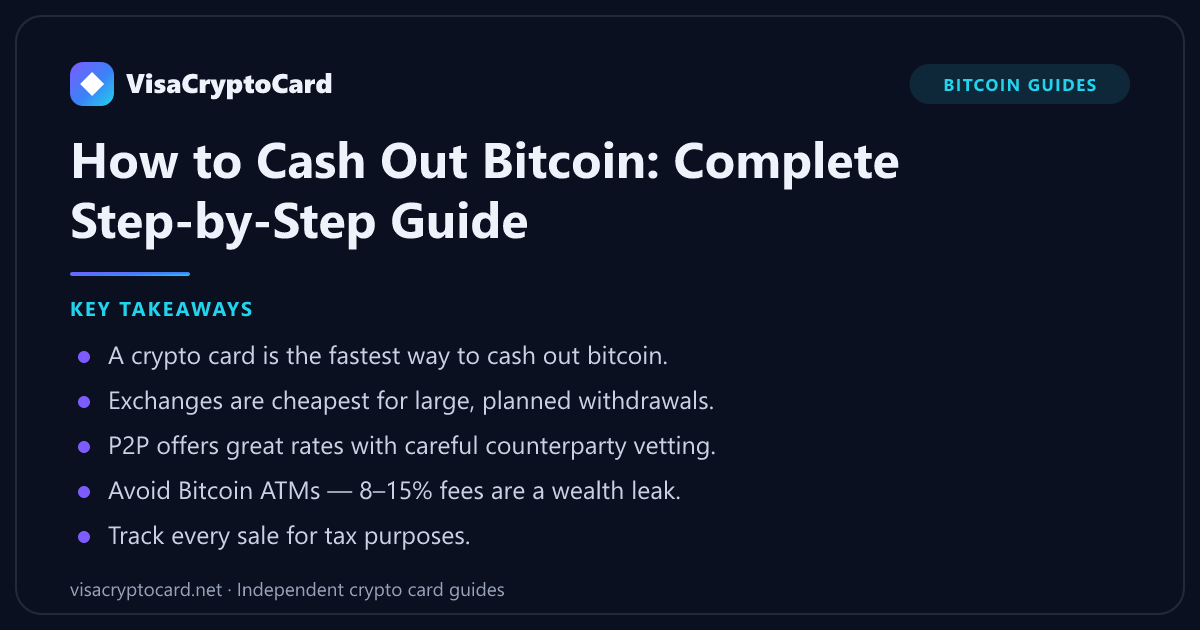
- A crypto card is the fastest way to cash out bitcoin.
- Exchanges are cheapest for large, planned withdrawals.
- P2P offers great rates with careful counterparty vetting.
- Avoid Bitcoin ATMs — 8–15% fees are a wealth leak.
- Track every sale for tax purposes.
Ready to Spend Your Crypto?
Compare crypto cards on fees, limits and availability, then open an account with the provider that fits how you spend.
Get Your Card →Frequently Asked Questions
How long does it take to cash out bitcoin?
With a crypto card, it is instant — BTC converts to cash the moment you pay or withdraw from an ATM. Exchanges take 1–5 business days to reach your bank, and P2P takes minutes to hours.
What is the cheapest way to cash out bitcoin?
Exchanges are typically cheapest overall (0.5–1.5%), and P2P can match them on rate. Crypto cards are the cheapest instant option at 1–2%. Bitcoin ATMs are by far the most expensive.
Can I cash out bitcoin without ID verification?
Legitimate providers require identity verification for security and compliance. Anonymous options exist but carry high fees, scam risk, and no consumer protection. A regulated route is safer.
Common Mistakes When Cashing Out Bitcoin (and How to Avoid Them)
Most problems people hit when they cash out bitcoin are not technical — they are mistakes that are easy to prevent once you know they exist. Here are the four most common, and how to avoid each one.
Mistake 1: Cashing out everything at once. Selling your entire position in a single transaction locks in one rate and one tax event, often at the worst possible moment. Cashing out in stages — say, a third now, a third after the next market move, and a third on a schedule — gives you better average prices and spreads the tax impact across periods.
Mistake 2: Ignoring network fees. Bitcoin transaction fees spike during busy periods. Sending BTC to an exchange when fees are high can eat 1–3% of a small withdrawal. Check the current fee level before moving funds, and wait for a quiet period when the amount is small enough that the wait costs you less than the fee.
Mistake 3: Sending to the wrong address or network. Double-check the full address and the network — sending BTC over the wrong chain can permanently lose your funds. Copy addresses from the withdrawal form, never from memory, and send a small test transaction first when the amount is significant.
Mistake 4: Forgetting the tax record. Every sale of BTC to cash is a taxable event in most countries. Keep the date, amount sold, and rate for each transaction. A few minutes of bookkeeping per withdrawal saves hours at tax time.
A Quick Comparison: Card vs. Exchange vs. P2P
If you are choosing between methods, this short comparison summarizes the trade-offs for a typical withdrawal of $500.
Crypto debit card. Instant access, 1–2% total cost, no bank account needed, and cash at ATMs. Best when speed and convenience matter more than saving a few dollars.
Centralized exchange. Best rates at 0.5–1.5%, but you wait 1–3 business days for the bank transfer and must complete verification. Best for larger amounts with time to spare.
P2P platforms. Competitive rates and flexible payment methods like mobile money, with settlement in minutes. The trade-off is counterparty risk — always trade inside the platform's escrow with verified users.
Crypto ATM. Fast but the most expensive at 5–10%, so keep it for emergencies or small amounts.
Many experienced users combine methods: the card for everyday spending and emergencies, an exchange for large conversions, and P2P when the rate justifies the extra care.
Whatever route you take, start with a small test withdrawal, confirm every detail twice, and keep records. With those habits in place, cashing out bitcoin becomes a routine five-minute task rather than a stressful event.
Start Cashing Out Crypto Today
Pick the card that fits your country and spending, then open an account with the provider directly. Our comparison shows the fees and limits first.
Get Your Card →