A crypto card links a card network like Visa or Mastercard directly to your digital assets, which makes crypto card security a different challenge than protecting a normal bank card. There is no central bank to reverse a bad transaction, and a stolen balance can move irreversibly in seconds. The good news is that modern providers have closed most of that gap with real safeguards. This guide explains exactly how crypto card security works, what separates a well-protected card from a risky one, and the habits that keep your balance safe.
How Crypto Card Security Actually Works
A regulated crypto card sits on top of several layers of protection, not just one. Your identity is verified at signup (KYC), your login is protected by two-factor authentication, your spending is capped by limits you control, and your transactions are screened in real time for suspicious patterns. Behind the scenes, your crypto balance is typically held by a licensed custodian, converted to fiat only at the moment of a purchase, and the card itself never exposes your wallet's private keys. No single layer is perfect on its own — the security comes from all of them working together.
Two-Factor Authentication and Login Protection
Two-factor authentication (2FA) is the first and most important layer. It means a password alone can never unlock your account — a stolen password without your phone or authenticator app is useless to an attacker. Authenticator apps (like Google Authenticator or Authy) are stronger than SMS codes, because SMS can be intercepted through a SIM-swap attack. Whenever a provider offers a choice, use an authenticator app or a hardware security key instead of text messages, and never reuse your card account password anywhere else.
Instant Card Freezing and Spending Controls
Reputable crypto card apps let you freeze and unfreeze your card instantly from your phone — no phone call, no waiting on hold. If your card is lost, or you simply cannot find it, freezing it within seconds stops new transactions immediately. Good providers go further with granular controls: per-transaction limits, daily and monthly caps, geographic restrictions, and toggles for online purchases, ATM withdrawals, or contactless payments. Setting conservative limits by default and raising them only when you need to is one of the simplest ways to cap your maximum loss if a card is ever compromised.
Virtual Cards, Tokenization, and Safer Checkout
A virtual card gives you a card number that exists only in an app, with no physical card to lose or skim. Because you can generate a new virtual card number in seconds, many people use a separate one for each merchant or subscription — if one number leaks in a data breach, you cancel just that card and every other purchase stays unaffected. Tokenization adds another layer for digital wallets like Apple Pay and Google Pay: your real card number is never sent to the merchant at all. Instead, a one-time token authorizes the payment, so even a compromised merchant database never reveals your actual card details.
Fraud Monitoring and Chargeback Protection
Behind every transaction, card networks and issuers run automated fraud detection that flags unusual spending — a purchase in a country you have never visited, an unusually large amount, or a rapid sequence of charges. Suspicious activity can trigger a temporary hold or a verification prompt before the charge goes through. Regulated crypto cards running on Visa or Mastercard rails also inherit standard chargeback rights, which let you dispute unauthorized or fraudulent charges — a protection that fully unregulated, no-KYC cards typically cannot offer, since they sit outside the card networks' dispute process entirely.
Cold Storage vs. Card Balance: What to Keep Where
The single biggest security decision is how much crypto you keep loaded on a card versus in cold storage. Treat your card balance like a wallet in your pocket, not a savings account: load only what you plan to spend in the near term, and keep the bulk of your holdings in a hardware wallet or another cold-storage setup that never touches an internet-connected app. If a card provider is ever hacked or a device is stolen, the damage is limited to whatever balance was sitting on the card at that moment. Top up in smaller, more frequent amounts rather than loading a large sum all at once.
Ready to Spend Your Crypto?
Compare crypto cards on fees, limits and availability, then open an account with the provider that fits how you spend.
Get Your Card →Common Crypto Card Scams and How to Avoid Them
- Phishing sites — fake login pages that mimic a real provider to steal your password and 2FA code. Always type the provider's URL directly instead of clicking links in emails or messages.
- Fake "support" agents — scammers posing as customer support in chat apps or social media, asking for your seed phrase or a one-time code. No legitimate provider ever needs your seed phrase or verification code.
- Too-good-to-be-true cashback — offers of unrealistic rewards designed to lure you into loading a balance onto an unregulated card that later vanishes.
- Fake card-loading apps — cloned apps outside official app stores that capture your credentials on install. Only download provider apps from the official App Store or Google Play listing.
- SIM-swap attacks — attackers hijack your phone number to intercept SMS codes. An authenticator app avoids this risk entirely.
The pattern behind almost every scam is urgency and a request for something a legitimate provider would never ask for. Slow down, verify the source independently, and never share a seed phrase, a 2FA code, or a password with anyone.
Choosing a Provider With Strong Security
Before loading real funds onto any crypto card, check for five concrete signals. First, a clear regulatory status and a licensed banking or custodial partner, not a vague claim of being "compliant." Second, mandatory 2FA with support for authenticator apps, not just SMS. Third, instant in-app card freezing and configurable spending limits. Fourth, a published incident history — how the provider has handled past security issues says more than any marketing page. Fifth, a real, responsive support channel you can test before you commit funds. A provider that is transparent about all five is almost always safer than one that only advertises high cashback rates.
What to Do If You Suspect Fraud on Your Card
Speed matters more than anything else once you notice a charge you do not recognize. Freeze the card immediately from the app — this stops any new authorizations while you investigate. Next, change your account password and rotate your 2FA method if there is any chance your login was exposed, since a frozen card alone will not stop someone who still has access to your account settings. Then review your full transaction history for any other unfamiliar activity, not just the one charge that caught your attention, since fraudulent transactions often come in small batches designed to stay under the radar.
Contact support through the provider's official app or website — never through a phone number or link sent to you unprompted, since that is a common follow-up scam targeting people who were just defrauded. Ask for a written record of the dispute and the timeline for a decision. If the card runs on Visa or Mastercard rails, you have standard chargeback rights, so keep screenshots of the suspicious transactions and any communication with support. Finally, once the immediate threat is contained, move any remaining balance off the card and into cold storage until you are confident the account is secure again.
Key Takeaways
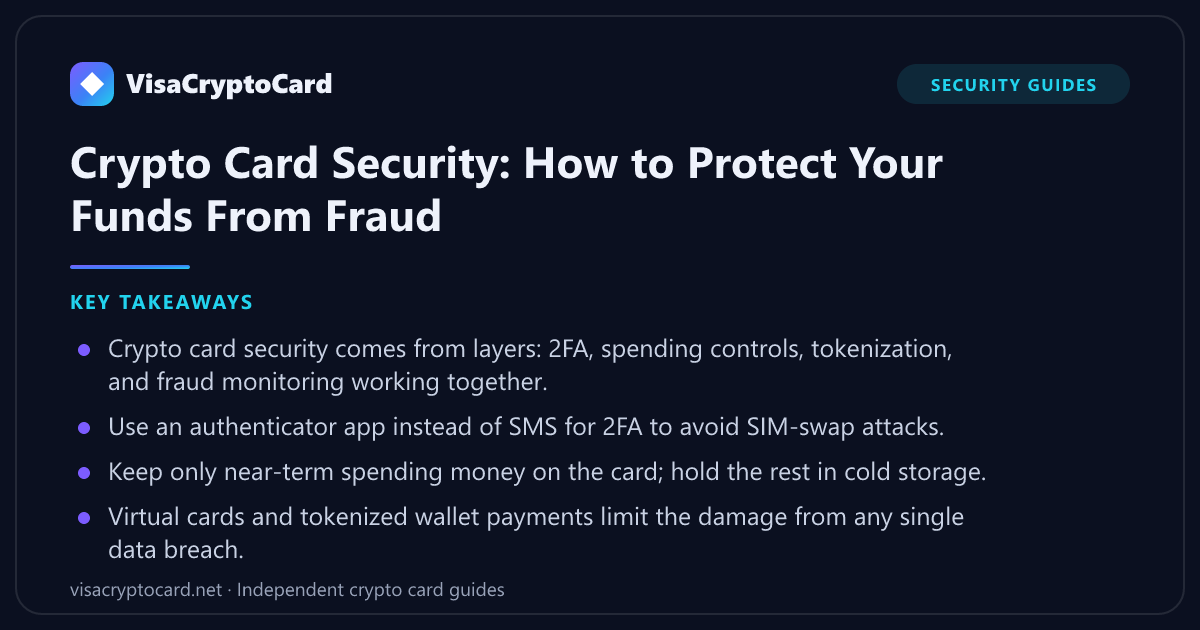
- Crypto card security comes from layers: 2FA, spending controls, tokenization, and fraud monitoring working together.
- Use an authenticator app instead of SMS for 2FA to avoid SIM-swap attacks.
- Keep only near-term spending money on the card; hold the rest in cold storage.
- Virtual cards and tokenized wallet payments limit the damage from any single data breach.
- Never share a seed phrase, password, or 2FA code — no legitimate provider will ask for one.
Frequently Asked Questions
Is it safe to keep a large crypto balance on a card?
No — treat a card balance like cash in your wallet. Load only what you plan to spend soon and keep the rest in cold storage, so a lost card or compromised account limits your exposure.
What should I do immediately if my crypto card is lost or stolen?
Freeze the card instantly in the provider's app, then contact support to confirm the freeze and review recent transactions. Reputable providers let you do this in seconds without a phone call.
Are virtual crypto cards safer than physical ones for online shopping?
Generally yes. A virtual card can be generated per merchant and canceled instantly if it ever leaks, so a single data breach never exposes the card you use everywhere else.
Start Cashing Out Crypto Today
Pick the card that fits your country and spending, then open an account with the provider directly. Our comparison shows the fees and limits first.
Get Your Card →