A free crypto debit card sounds like the perfect deal: no monthly fee, no annual charge, and crypto converted to cash at the register. But "free" in the card industry rarely means zero cost — it usually means zero subscription fee, with the real costs hidden in spreads, ATM charges, and conversion markups. This guide explains exactly what a free crypto debit card costs in 2026, which fees to watch for, and how to pick one that is genuinely cheap, not just free to order.
What "Free" Actually Covers
When a provider advertises a free crypto debit card, the free part usually covers the card issuance and the monthly subscription. Many crypto cards charge a monthly fee of $5–15, so a free tier is genuinely valuable for light users. You typically still pay for the things that cost the provider money: the conversion spread when crypto becomes fiat, ATM withdrawals beyond a monthly allowance, foreign exchange on non-USD spending, and card delivery if you want it expedited.
The key insight is that a free card and a cheap card are different products. A card with a $10 monthly fee but a 0.1% spread can be cheaper in practice than a free card with a 2% spread, once you move meaningful volume. The monthly fee is visible; the spread is not. Savvy users estimate their monthly spend and compare the total cost, not the subscription line.
The Hidden Costs of Free Cards
- Conversion spread — often 0.5–2% above the market rate on every crypto-to-fiat conversion.
- ATM fees — free cards usually include a small monthly ATM allowance (e.g., $200–500), then charge per withdrawal.
- Foreign exchange — 1–3% on spending in a currency other than your card's base currency.
- Inactivity fees — charged after months without a transaction on some cards.
- Card replacement — a fee when you lose the physical card.
- Top-up fees — charged on certain funding methods or networks.
Free vs. Paid Cards Compared
Paid cards justify their subscription with benefits: higher ATM limits, lower or zero spreads, cashback, and premium support. If you spend more than a few hundred dollars a month in crypto, the paid tier often pays for itself. If you spend occasionally, a free tier keeps your costs near zero as long as you stay inside the free allowances.
The decision rule is simple. Estimate your monthly card volume, your ATM withdrawals, and how often you spend in foreign currencies. Compute the total cost on both the free and paid tiers. Pick whichever is cheaper — and remember that a low spread matters more than a zero subscription once your volume grows.
ATM Withdrawals and Free Tiers
ATM access is where free card tiers differ most. Some free plans include a monthly withdrawal allowance of $200–500 with no fee; beyond that, each withdrawal costs $1–3 or a percentage. Others charge per withdrawal from the first dollar. If you rely on ATM cash, check three numbers before ordering: the monthly free allowance, the per-withdrawal fee, and any percentage markup on top.
A practical strategy is to consolidate withdrawals: take out larger amounts less often to stay inside the free allowance, rather than paying per-transaction fees on small cash runs. The conversion itself is the same either way, so the only variable you control is the number of fee-charging withdrawals.
Ready to Spend Your Crypto?
Compare crypto cards on fees, limits and availability, then open an account with the provider that fits how you spend.
Get Your Card →How to Pick a Genuinely Cheap Card
- Add up the effective rate: spread + any fixed fee, not just the subscription.
- Check the ATM allowance against your actual cash needs.
- Confirm the card's base currency matches yours to avoid FX fees.
- Read the fee schedule for inactivity, replacement, and top-up charges.
- Look for a provider with transparent pricing — no surprise deductions.
- Start small: order the card, run a few transactions, and review your statements.
Real-World Scenario: Two Users, Two Cards
Compare two users with different habits. One spends $150 a month in crypto at the register, never uses ATMs, and stays in one currency — a free card with a 1% spread costs them about $1.50 a month in hidden spread. Another spends $2,000 a month, withdraws $600 in cash, and travels across borders — the same free card costs them $20 in spread, $12 in ATM fees, and 3% FX on a third of their spending, for a total near $50. The second user would be far better served by a paid card with a 0.2% spread, a higher ATM allowance, and 0% FX — even at a $10 monthly fee.
This is why "free" is not the same as "cheap." Your habits determine which card actually saves you money, and the calculation changes as your volume grows. Revisit it every six months or whenever your spending pattern shifts.
How Free Crypto Cards Make Money
Understanding how a card issuer earns money tells you exactly where the costs hide. The primary revenue streams are the conversion spread on every crypto-to-fiat transaction, the interchange fee the merchant pays when you use the card, ATM fees beyond the free allowance, foreign-exchange markups, and interest on the funds the issuer holds in custody. A free subscription card simply shifts the revenue model: instead of charging you a monthly fee, the issuer earns on every transaction you make. That is not a scam — it is how prepaid and debit cards have always worked — but it explains why a free card is not a zero-cost card.
The practical takeaway: the more transactions you run through a free card, the more the issuer earns from you. For light users this is negligible. For heavy users, the accumulated spread and fees can exceed what a paid tier would have cost. Run the numbers on your own monthly volume before assuming free is cheaper — the issuer certainly has.
Free Card vs. Prepaid Card: Same Thing?
The terms are often used interchangeably, but there is a meaningful difference. A crypto debit card is typically linked to a wallet balance and converts crypto to fiat at the point of sale. A crypto prepaid card is loaded with value in advance — you top it up, and the balance is spent down. Many crypto cards are technically prepaid in structure, since there is no credit line involved. For practical purposes the distinction matters less than the fee schedule: check the top-up cost, the conversion spread, and the ATM allowance regardless of which label the provider uses.
Building a No-Surprise Spending Habit
The best defense against hidden card costs is a simple monthly review. At the end of each month, open the card's transaction history and look at three things: the total in conversion spreads, any ATM fees, and any FX charges. Compare that against what you would have paid on a paid tier or an exchange transfer. If the gap is small, your free card is doing its job. If the costs are creeping up as your volume grows, switch tiers or move large withdrawals to an exchange. Fifteen minutes a month is all it takes to stay on the cheap side of your own habits.
Are There Truly Zero-Fee Crypto Cards?
Cards with literally zero fees on every operation are rare, and those that exist usually recover costs through the spread — which is itself a fee, just an invisible one. A few providers offer very low spreads on stablecoin conversion, since USDT and USDC are already pegged near $1, but even those charge for ATM cash or foreign exchange. The honest answer: zero visible fees exist, but zero total cost does not. Treat any "no fees anywhere" claim with healthy skepticism and verify the spread yourself.
Key Takeaways
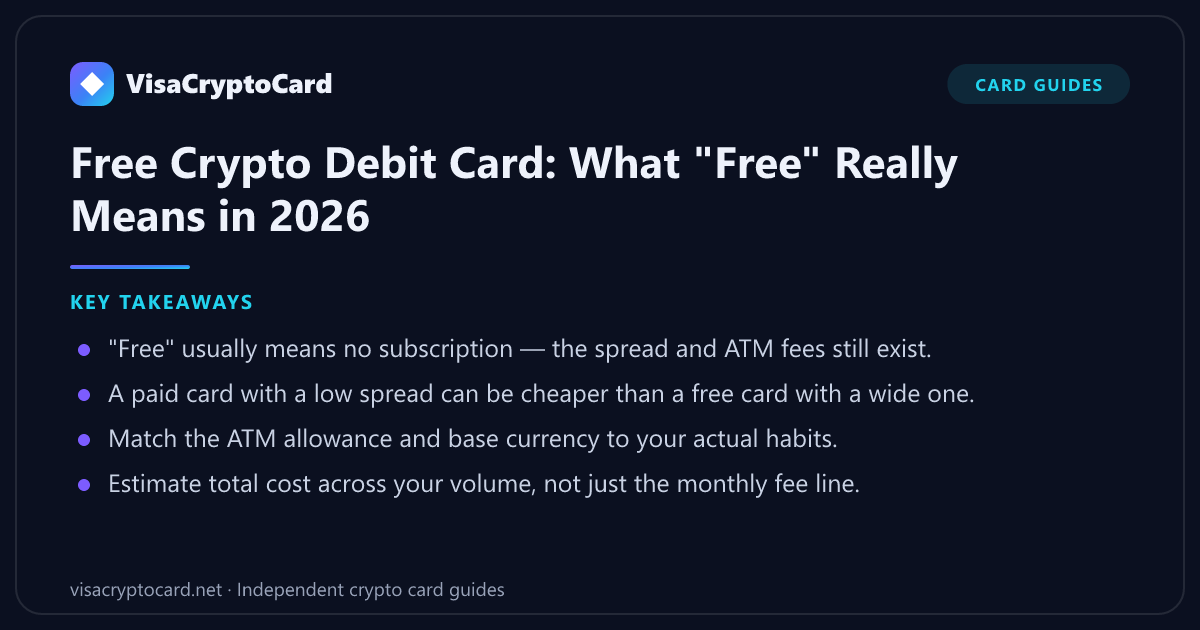
- "Free" usually means no subscription — the spread and ATM fees still exist.
- A paid card with a low spread can be cheaper than a free card with a wide one.
- Match the ATM allowance and base currency to your actual habits.
- Estimate total cost across your volume, not just the monthly fee line.
Frequently Asked Questions
Is a free crypto debit card actually free?
The card and subscription are free, but you still pay a conversion spread and, beyond any allowance, ATM and foreign-exchange fees. Estimate your total cost — the spread usually matters more than the subscription.
What is the cheapest way to use a crypto debit card?
Stay inside the free ATM allowance, spend in your card's base currency, and use a card with a low conversion spread. For stablecoins like USDT, conversion cost is minimal because the value is already pegged near $1.
Do free crypto cards charge for ATM withdrawals?
Most include a small monthly free allowance, then charge per withdrawal beyond it. Check the allowance before ordering if you rely on ATM cash.
Is a paid crypto card ever worth it?
Yes — for high-volume users, travelers spending in multiple currencies, and heavy ATM users. The subscription is easily offset by lower spreads, higher ATM limits, and 0% FX.
The Bottom Line on Free Crypto Debit Cards
A free crypto debit card is an excellent starting point: it removes the monthly commitment and lets you test crypto spending with minimal risk. The key is knowing where the costs actually hide. Check the spread, the ATM allowance, the FX rate, and the inactivity policy before you commit. For light, single-currency, card-only use, free is genuinely free. For heavy or international use, run the numbers on a paid tier as well — the visible subscription is often cheaper than the invisible spread.
Start Cashing Out Crypto Today
Pick the card that fits your country and spending, then open an account with the provider directly. Our comparison shows the fees and limits first.
Get Your Card →