Traditional international money transfers are slow, expensive, and full of intermediaries: banks, correspondent networks, and currency-conversion markups that quietly swallow 5–10% of every dollar sent home. Sending money abroad with crypto removes most of that chain. A stablecoin transfer can cross borders in minutes for pennies, and a crypto card lets the recipient spend instantly without ever touching a bank. This guide explains how crypto remittances work, the four main methods, real fees and speeds, step-by-step instructions, and the legal and tax points you cannot ignore.
Why Send Money Abroad with Crypto?
The first reason is cost. Traditional remittance corridors often charge 5–7% in fees and FX markups on top of a slow settlement time of one to five business days. A stablecoin transfer typically costs under 1% — often just a few cents of network fee — and settles in minutes. For a worker sending $300 home every month, that difference is meaningful over a year.
The second reason is speed and availability. Crypto transfers run 24/7, every day of the year, with no banking hours, no holidays, and no "weekend processing". The money moves when you send it, not when a bank opens. For emergency support to family — a medical bill, a repair, a school fee — that immediacy is the whole point.
The third reason is access. Millions of people in receiving countries are underbanked or face capital controls that make bank transfers painful. Crypto needs nothing but a smartphone and a wallet. Recipients can hold the value in stablecoins, spend it with a crypto debit card, or convert to local cash at their own pace. In countries with weak or volatile currencies, receiving stablecoins also protects the value of the transfer until it is spent.
How Crypto Remittances Work
A crypto transfer replaces the correspondent-bank chain with a blockchain settlement. You send value from your wallet to the recipient's wallet address; the network confirms it; the recipient now controls the funds. Because there is no central clearinghouse, the cost is just the network fee, and the speed is the network's confirmation time.
Stablecoins — USDT, USDC, and similar — are the workhorses of crypto remittance because their value is pegged to the dollar. The sender buys or already holds stablecoins, sends them to the recipient's wallet, and the recipient either holds, sells, or spends them. Volatile assets like Bitcoin work too, but price movement during the transfer makes them riskier for people who need a predictable amount. For most family transfers, stablecoins are the right choice.
The Four Main Methods Compared
1. Stablecoin Transfer (Cheapest)
Send USDT or USDC directly from your wallet to the recipient's wallet. Cost is the network fee — often under $0.01 on Tron or Solana — and settlement takes seconds to minutes. The recipient can then cash out locally, spend with a card, or keep the stablecoins. This is the method to use when both sides are comfortable with wallets.
2. Crypto Debit Card for the Recipient (Easiest)
Instead of sending coins at all, fund a shared wallet or card and let the recipient spend directly with a physical crypto card — at shops, online, and ATMs. No exchange account, no selling, no local crypto market needed. This is ideal for family members who are not crypto-savvy: they just use a card, and you handle the crypto side.
3. Exchange-to-Bank Payout
Send crypto to a centralized exchange in the receiving country that supports local bank withdrawals. The exchange credits the local currency to the recipient's bank account. This gives the recipient familiar bank money, but adds exchange withdrawal fees and a possible local withdrawal delay — typically the same day.
4. Peer-to-Peer (P2P) Networks
On P2P marketplaces, you sell your crypto to a local buyer in the receiving country who pays the recipient in cash or mobile money — often M-Pesa, GCash, or similar. P2P offers excellent rates and works where exchanges do not, but requires trusting the counterparty and following escrow rules carefully. Start with small amounts until you build a track record.
Step-by-Step: Your First Crypto Transfer Abroad
- Pick the method — stablecoin transfer for cost, a card for recipient ease, exchange payout for bank money, P2P for local-cash delivery.
- Set up wallets — both sides need a wallet that supports the same network. USDT on Tron (TRC-20) and USDC on Solana are popular for low fees.
- Verify addresses — send a tiny test transfer first, confirm the recipient received it, then send the full amount to the exact same address.
- Choose the network — pick a cheap, fast network; avoid Ethereum for small transfers when its gas fees are high. Never send on the wrong network — funds can be lost.
- Send and confirm — the recipient confirms receipt in their wallet. Screenshot the transaction ID for your records and for any support issue.
- Recipient converts or spends — they can hold, sell to local cash, or spend with a card. If they are new to crypto, walk them through their first cash-out together.
Ready to Spend Your Crypto?
Compare crypto cards on fees, limits and availability, then open an account with the provider that fits how you spend.
Get Your Card →Fees and Speed Compared
- Stablecoin transfer — under 1% total; network fee only, usually under $1. Speed: seconds to minutes.
- Crypto card spending — 0.5–1.5% conversion spread; no transfer fee at all. Speed: instant at checkout.
- Exchange-to-bank — 0.1–1% trading fee plus a local withdrawal fee (often $1–5). Speed: minutes to same day.
- P2P — 0.5–2% markup depending on the market. Speed: minutes to hours, depends on the buyer.
- Traditional bank transfer — 5–10% all-in with FX markups. Speed: 1–5 business days.
The pattern is consistent: crypto remittances are dramatically cheaper and faster than the traditional route, with stablecoin transfers the clear winner on both. The real cost variable is not the network — it is how the recipient converts crypto to local money, which is why choosing a receiving method with a cheap cash-out path matters as much as the transfer itself.
Legal, Tax, and Compliance Considerations
Sending money internationally with crypto is legal in most countries, but the rules around it are tightening. Regulators increasingly treat crypto transfers like any financial movement: large amounts may trigger reporting requirements, and countries with capital controls restrict how much can leave. Check the sending and receiving countries' limits before moving serious money.
On taxes, the key point is that using crypto is a taxable event in many jurisdictions. Converting BTC or ETH to stablecoins to send abroad is a disposal — it may trigger capital-gains tax at the market rate of conversion. Stablecoins sent as a gift may be subject to gift rules, and money sent for services is income in the receiving country. Keep records: dates, amounts, wallet addresses, and the fiat value at each step. A simple spreadsheet today saves a painful reconstruction during tax season.
Finally, use regulated exchanges and known providers for the on- and off-ramps. Unregulated services may offer better rates but carry real risk of freezing funds, disappearing, or facilitating fraud — none of which ends well for the family waiting on the money.
Risks and How to Manage Them
- Wrong network or address — the classic crypto-loss scenario. Always send a test transfer and double-check the address and network before the real amount.
- Price volatility — sending Bitcoin that drops during the transfer shortchanges the recipient. Use stablecoins when the amount must be exact.
- Scams and phishing — "support" agents, fake wallet apps, and lookalike addresses steal real money. Only use official apps and verified links.
- Regulatory freezes — an exchange flagged for suspicious activity can freeze withdrawals. Keep records that show the legitimate purpose of each transfer.
- Recipient mistakes — a family member sending coins to the wrong address is unrecoverable. Help them store their recovery phrase offline and practice with small amounts.
When Crypto Remittances Are the Best Choice
Crypto wins clearly in three situations. First, frequent small transfers: where bank fees eat a big share of every transfer, a stablecoin transfer at near-zero cost preserves the full amount. Second, same-day urgent needs: medical bills and emergencies that cannot wait for a three-day bank settlement. Third, underbanked recipients: family in countries with limited banking, capital controls, or weak currencies, where a smartphone wallet and a crypto card outperform any bank product available locally.
Traditional banks still make sense for very large, one-off transfers where you value the regulatory paper trail and the recipient insists on bank money. But for the monthly rhythm of support payments — the way most remittances actually happen — crypto is now the better tool. Start small, test the full loop with a tiny transfer, and scale up once the recipient is comfortable. That is how thousands of families have moved their remittances to crypto, and it is the safest way to do the same.
Key Takeaways
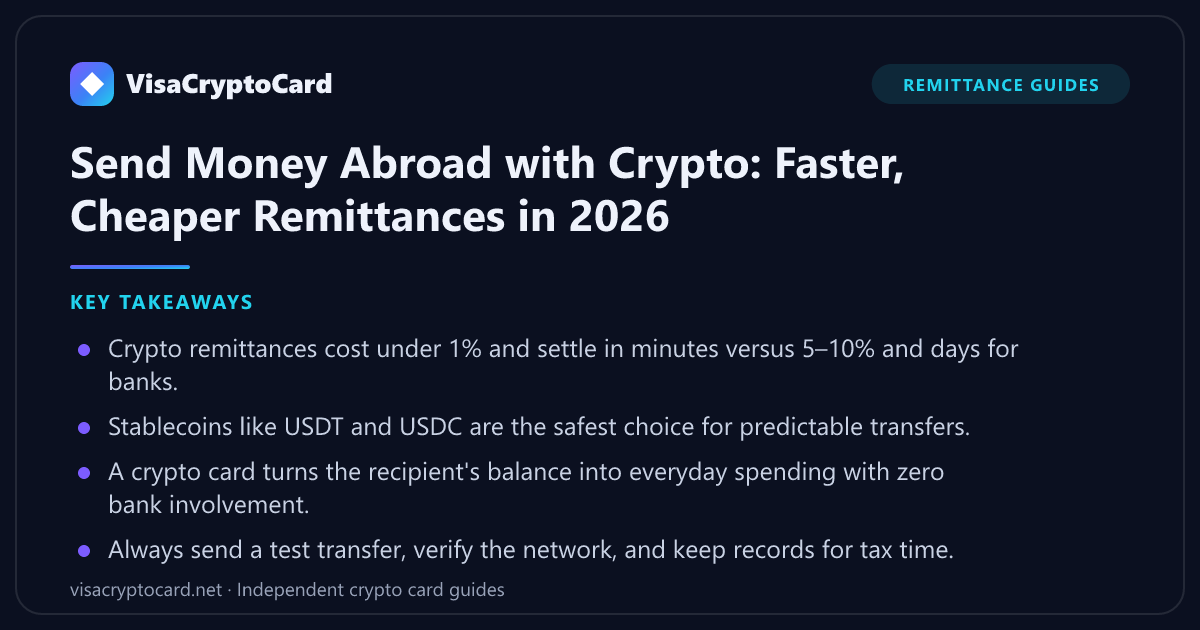
- Crypto remittances cost under 1% and settle in minutes versus 5–10% and days for banks.
- Stablecoins like USDT and USDC are the safest choice for predictable transfers.
- A crypto card turns the recipient's balance into everyday spending with zero bank involvement.
- Always send a test transfer, verify the network, and keep records for tax time.
Frequently Asked Questions
How long does it take to send money abroad with crypto?
A stablecoin transfer settles in seconds to minutes depending on the network. Exchange-to-bank payouts add a local withdrawal step that usually completes the same day. Either way, it is a fraction of the one-to-five business days traditional banks need.
How much does it cost to send crypto internationally?
Direct stablecoin transfers cost only the network fee — often under $1 regardless of the amount. Exchange withdrawals add a small local fee, and P2P adds a market markup. Total cost is typically under 2%, compared with 5–10% for traditional remittances.
Is sending money with crypto legal?
Yes in most countries, but limits and reporting requirements apply. Check the sending and receiving countries' rules for large amounts, use regulated exchanges, and keep records of the purpose of each transfer.
What is the safest crypto to send abroad?
Stablecoins — USDT or USDC — are safest for transfers because the value is pegged to the dollar and does not move during the transfer. Choose a network with low fees like Tron or Solana, and always send a small test transaction first.
Start Cashing Out Crypto Today
Pick the card that fits your country and spending, then open an account with the provider directly. Our comparison shows the fees and limits first.
Get Your Card →